
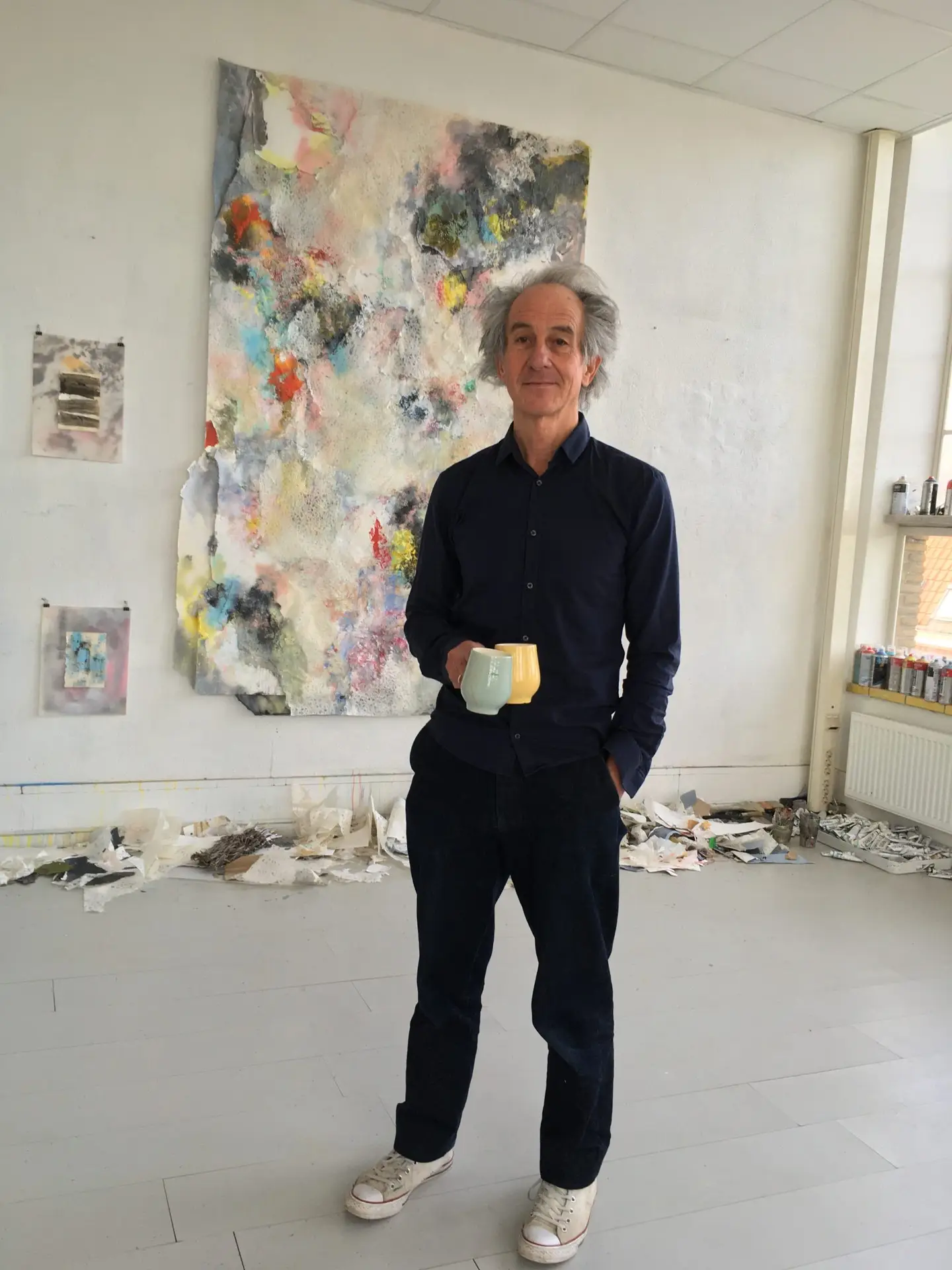
Lex’s work is part of what he calls *The Alphabet of Lost Order*. This title encapsulates his search for the lost order between humanity and nature, as well as between humanity and language. Neither system is sufficient anymore to sustain our relationship with the world: they have lost their familiarity and their self-evidence. In his work, he examines the traces that remain of this order and transforms them into a new one—an order that can bring a new dimension to our lives.
He finds traces of the lost order in the structures of trees, roots, upturned soil, the wild growth of branches and undergrowth, and the biting wind in open spaces. But also in graffiti, eroded words, marks in the sand, and the randomness of what has grown, been written, and multiplied. Within this unknown (dis)order lies the foundation of a new order.
His work draws on classical Chinese landscape art, which is not about realism but about an idea: the landscape as a unity of opposites. For Lex ter Braak, this represents the ever-evolving unity of the old and the new order.
Lex ter Braak studied comparative literature in Amsterdam and attended the Rietveld Academy. He has written about visual art and literature for weekly magazines and art journals and has published several books, including his recent concept novel *Levensvormen* (2021). His works have been acquired by collectors and included in public collections.
He has recently exhibited at venues such as Nieuw Dakota in Amsterdam, Art Brussels, Art Rotterdam, and his own gallery, dudokdegroot in Amsterdam. In 2025, JapsamBooks will publish a book on his work, accompanied by various presentations. In addition, he has several exhibitions scheduled, including the Paper Biennale.